How to Administer an Irish Estate from Abroad: A Guide for Overseas Executors
Appointed executor of an Irish will but living in the UK, USA or another country? Discover how Irish probate works, what documents you may need, and how an Irish solicitor can help you administer an estate from overseas.
Being appointed as the executor of a will is an important responsibility. When you live outside Ireland, however, dealing with an Irish estate can feel particularly daunting.
You may have to manage property in Ireland, communicate with Irish banks, gather legal documents, deal with inheritance tax requirements and arrange for assets to be transferred to beneficiaries — all while living in another country.
The good news is that living abroad does not automatically prevent you from acting as executor of an Irish estate. However, the probate process may involve additional legal and practical requirements, particularly where an executor is resident outside Ireland or the deceased had assets in more than one country.
Cullen & O’Beirne Solicitors in Greystones, County Wicklow understand the difficulties overseas families can face when dealing with an estate in Ireland.
This guide explains the main steps involved in administering an Irish estate from abroad and the circumstances in which professional legal assistance may be needed.
What Does It Mean to Administer an Irish Estate?
When someone dies, their estate generally consists of the assets and liabilities they leave behind. These may include:
A house, apartment or land in Ireland
Money held in Irish bank or credit union accounts
Shares, investments or other financial assets
Personal possessions and other property
Outstanding mortgages, loans, bills or other debts
If the deceased left a valid will, the person or people appointed to carry out its instructions are known as executors.
An executor’s responsibilities typically include identifying and protecting estate assets, establishing the deceased’s debts and liabilities, obtaining a Grant of Probate where required, paying the estate’s properly payable debts and expenses, addressing relevant tax obligations and distributing the remaining estate in accordance with the will.
These responsibilities do not disappear because an executor lives outside Ireland.
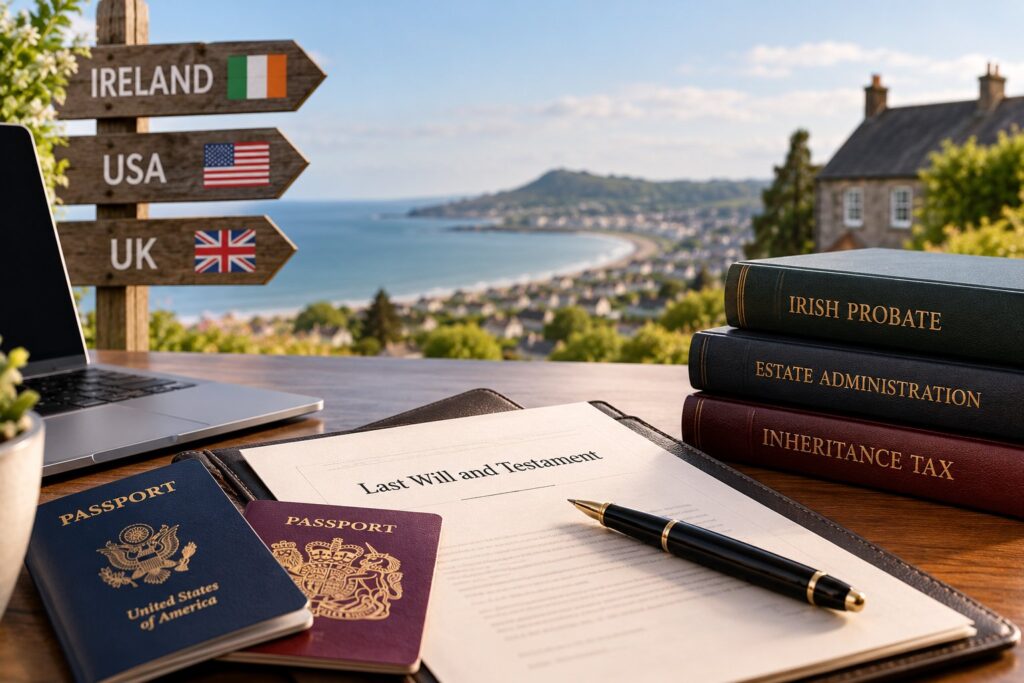
Can You Be an Executor of an Irish Will If You Live Abroad?
Yes. An executor named in an Irish will may live in the United Kingdom, United States or another country.
However, an executor’s overseas residence can affect how an Irish grant of representation is obtained.
In some circumstances, an executor living abroad may appoint an attorney to apply for a grant on their behalf. This may involve an application for a Grant of Administration with Will Annexed, rather than an ordinary Grant of Probate.
The correct procedure depends on the circumstances, including whether there are other executors, where they live and whether they intend to act.
For example, if a will appoints two executors and one lives in Ireland while the other lives in the USA, the appropriate application procedure may differ from a case where every appointed executor lives abroad.
It is therefore important to obtain advice on the correct procedure before preparing or signing probate documentation.

What Is Probate in Ireland?
Probate is the legal process through which the Irish Probate Office or a District Probate Registry confirms the authority of an executor to administer an estate under a will.
Where the deceased left a valid will and the appointed executor applies, the relevant document is generally a Grant of Probate.
Where there is no will, or where the named executor cannot or does not act, a different type of grant may be required, depending on the circumstances.
A grant of representation may be needed before an executor or administrator can:
Sell or transfer a property forming part of the estate
Access certain bank accounts or investments
Collect and distribute estate assets
Deal with other assets for which formal proof of authority is required
Not every estate requires a grant. Whether one is needed depends on the nature of the assets and the requirements of the institutions involved
Step 1: Locate the Will and Establish Who Is Entitled to Act
The first step is to establish whether the deceased left a valid will and identify the executor or executors appointed under it.
The original will is particularly important. Any codicils — documents that amend or supplement the will — must also be identified.
If you live overseas, you may need to arrange for the original documents to be located and securely provided to the solicitor handling the estate.
You should also establish whether the deceased held assets outside Ireland, whether there are other executors and whether any questions arise concerning the will’s validity.
Important: Avoid removing staples, bindings or attachments from an original will. Alterations to the physical document can create questions during the probate application.
Step 2: Identify the Assets and Liabilities of the Estate
Before applying for probate, the executor must gather information about the deceased’s financial affairs.
This may involve contacting banks, financial institutions, insurers and other organisations to establish the assets held at the date of death.
If the deceased owned property in Ireland, it may also be necessary to obtain a date-of-death valuation.
The executor should identify outstanding debts and liabilities, including mortgages, loans, taxes and other expenses properly payable by the estate.
This information is required to prepare an accurate account of the estate and complete the relevant probate and Revenue documentation.
Where the executor lives overseas, an Irish solicitor can assist with communications and the practical arrangements involved in gathering information from institutions in Ireland.

Step 3: Prepare the Irish Probate Application
For most current probate applications, details of the deceased’s assets and liabilities must be submitted to the Revenue Commissioners using the Statement of Affairs (Probate), Form SA.2.
The information may be submitted by the personal representative or by a solicitor acting on their behalf.
Following submission, Revenue issues a Notice of Acknowledgement (Probate), which forms part of the probate application.
Depending on the type of grant sought, the application may also require documents such as:
The original death certificate or an acceptable interim certificate
The original will and any codicils
The appropriate executor’s oath or administrator’s oath
The relevant notice of application
Supporting documentation concerning the applicants’ entitlement to the grant
A power of attorney or additional documents where a special application procedure is required
The exact documentation differs according to the circumstances and the type of grant.
For estates involving a deceased person who was domiciled outside Ireland, additional documentation relating to a foreign probate application or foreign law may be required.
Step 4: Obtain the Grant of Representation
Once the application has been prepared, it is submitted to the appropriate Irish probate office.
For a deceased person whose last residence was in Wicklow, Dublin, Kildare or Meath, applications are dealt with by the Dublin Probate Office.
Applications involving a deceased person who lived outside the Republic of Ireland are also submitted to the Dublin Probate Office.
The Probate Office examines the application and may raise queries or request further documentation before issuing the grant.
Processing times vary. They depend on the nature of the application, the Probate Office’s workload and whether additional information is required.
An executor should therefore avoid assuming that probate will be completed within a fixed number of weeks or months.
Step 5: Deal with Irish Property and Other Assets
One of the most common difficulties for an overseas executor is dealing with a house or other property in Ireland.
For example, you may live in London, Boston or New York but have responsibility for administering the estate of a parent or relative who owned a home in Greystones, Bray, Dublin or elsewhere in Ireland.
Depending on the circumstances, you may need to arrange for:
The property to be secured and insured
A professional valuation
Ongoing mortgage payments or other necessary expenses
Maintenance and management of the property
A sale of the property or its transfer to a beneficiary
The discharge of liabilities affecting the property
Where a property is being sold, the executor will also need to consider the conveyancing requirements and ensure that the estate has the necessary legal authority to complete the transaction.
A solicitor experienced in both probate and property transactions can assist with the legal steps involved.
Step 6: Understand Irish Inheritance Tax Obligations
Tax is an important consideration when administering an Irish estate from overseas.
In Ireland, inheritance tax is generally dealt with under Capital Acquisitions Tax (CAT).
Whether CAT applies depends on several factors, including the relationship between the deceased and the beneficiary, the value of the inheritance, previous taxable gifts and inheritances, the location of the assets and the relevant residence and domicile rules.
Living outside Ireland does not automatically mean that an inheritance of Irish property is exempt from Irish inheritance tax.
For example, a person living in the United States or the United Kingdom who inherits a property situated in Ireland may have Irish CAT obligations, even though they are not resident in Ireland.
Beneficiaries may need to file an IT38 inheritance tax return and pay CAT where the applicable rules require it.
An executor should also consider the estate’s own tax affairs, including any relevant income tax or capital gains tax issues arising during administration.
Where beneficiaries or assets are located in more than one country, specialist tax advice may be necessary.
Ireland has arrangements with the United Kingdom and United States concerning relief from certain double taxation of inheritances. However, the availability of relief depends on the facts and the applicable rules.
Step 7: Pay Debts and Distribute the Estate
After the necessary grant has been obtained, the executor can progress the administration of the estate.
This generally involves collecting the assets, settling properly payable debts, expenses and taxes, and distributing the remaining estate to the beneficiaries in accordance with the will.
Executors should maintain accurate records of estate transactions and payments.
It is important not to distribute assets prematurely, particularly where debts, tax liabilities, creditor claims or other legal issues remain unresolved.
Once the estate has been fully administered, appropriate estate accounts should be prepared
Do You Have to Travel to Ireland to Administer an Estate?
Not necessarily.
Some aspects of estate administration can be managed through correspondence and by engaging an Irish solicitor to assist with the legal process.
However, particular documents may need to be signed or sworn in an approved manner, and the procedure may depend on where the executor resides and the type of grant required.
An executor should not assume that every document can be signed electronically or that an ordinary scanned signature will be accepted for probate purposes.
The appropriate signing and witnessing arrangements should be confirmed before documents are executed overseas.
How Can an Irish Solicitor Help an Executor Living Abroad?
Administering an estate involves legal duties, financial information and potentially substantial assets.
When the executor is based overseas, the additional distance can make the process more difficult.
An Irish solicitor can help by:
Advising on the correct type of Irish grant of representation
Explaining the requirements affecting executors who live abroad
Preparing and submitting probate documentation
Assisting with Revenue’s probate reporting requirements
Communicating with Irish financial institutions and relevant parties
Advising on the administration of Irish property
Assisting with the sale or transfer of estate property
Coordinating with foreign legal or tax advisers where appropriate
Guiding the executor through the legal responsibilities involved in administering the estate
The extent of the assistance required will depend on the circumstances of the estate.
Administering an Irish Estate from the UK, USA or Overseas? Contact Cullen & O’Beirne Solicitors
If you have been appointed executor of an Irish will but live outside Ireland, it is important to understand your responsibilities and the probate procedures that apply.
Whether you are dealing with a family home in County Wicklow, an inheritance involving Irish bank accounts, or an estate with assets in more than one country, obtaining appropriate advice at an early stage can help you avoid unnecessary complications.
Cullen & O’Beirne Solicitors, based in Greystones, County Wicklow, can assist with Irish probate and estate administration matters.
If you live in the UK, USA or elsewhere overseas and need assistance dealing with an estate in Ireland, contact Cullen & O’Beirne Solicitors to discuss your circumstances and the next steps.
Contact Cullen O’Beirne Solicitors Today
For more information on Wills and Probate Litigation, speak with a solicitor today