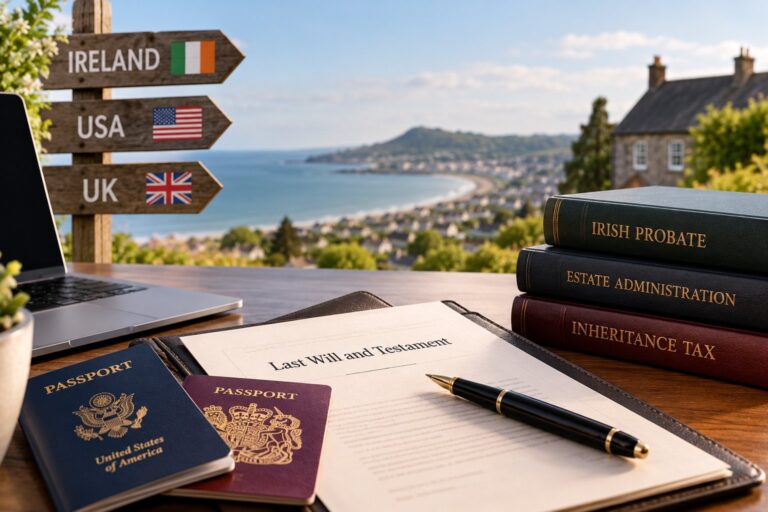
Dealing with Irish probate while living in the United States can feel overwhelming, particularly when you are grieving the loss of a family member. If you have been appointed executor of an Irish estate, or you are an American beneficiary inheriting property or money in Ireland, understanding the Irish probate process is an important first step.
Many American families discover that a loved one has left behind an Irish property, bank account, savings or other assets. Administering these assets from the USA can involve unfamiliar legal procedures, Irish documentation requirements, international communication and questions about inheritance tax in both countries.
Cullen & O’Beirne Solicitors understand the practical difficulties families can face when dealing with an estate from overseas. This guide explains the main steps involved in administering an Irish estate from America and the issues to consider before distributing an inheritance.
Do I Need Irish Probate If I Live in the USA?
If someone dies leaving assets in Ireland, an Irish Grant of Representation may be required before those assets can be collected, transferred or sold.
Irish probate is the legal process through which an executor obtains authority to administer the estate of someone who has died.
Where the deceased left a valid will, the relevant document is generally known as a Grant of Probate. Where there is no will, the appropriate grant may be Letters of Administration.
Whether a grant is required depends on the type of assets, how they were owned and the requirements of the institutions holding them.
For example, an Irish bank may require a grant before releasing funds, while an Irish property held solely in the deceased’s name will generally require a grant before it can be sold or transferred.
Living in America does not prevent you from dealing with an Irish estate. However, additional procedures may apply where the deceased or the executor lived outside Ireland.
How to Administer an Irish Estate from the United States
The process of estate administration in Ireland generally involves several stages.
1. Locate the Will and Identify the Executor
The first step is to establish whether the deceased left a valid will and who has been appointed to administer the estate.
If you are named as executor but live in the United States, you may need legal assistance in Ireland to determine how the application should proceed.
Where the deceased lived permanently in America, it is also important to establish whether probate proceedings have already taken place in a US state.
An American probate grant does not automatically give an executor authority to deal with every Irish asset. A separate Irish application or other procedure may be necessary.
2. Identify and Value the Irish Assets
Before applying for Irish probate, the executor must establish the nature and value of the deceased’s assets and liabilities.
Irish assets may include:
Residential property, holiday homes or inherited family property
Irish bank and credit union accounts
Shares, investments and savings
Personal possessions and valuables
Other property or financial interests held in Ireland
The executor will generally need appropriate valuations and account balances as at the date of death.
This can be particularly challenging when administering an estate from overseas, as banks, property professionals and other organisations may require formal documentation before releasing information.
3. Prepare the Irish Probate Documentation
Applying for a Grant of Probate in Ireland involves preparing the relevant estate information and supporting documents.
One important requirement is the Statement of Affairs (Probate), Form SA.2, which is submitted to the Irish Revenue Commissioners.
Depending on the circumstances, documents may include the deceased’s death certificate, original will, details of beneficiaries, information about assets and liabilities, and documentation relating to probate proceedings in the United States.
Where the deceased was domiciled outside Ireland, additional legal requirements may arise.
Having an Irish probate solicitor review the documentation at an early stage can help identify issues before an application is submitted.
4. Obtain the Irish Grant of Representation
Once the necessary information has been gathered and the application prepared, the relevant papers are submitted through the appropriate Irish probate procedure.
The Grant of Representation establishes the legal authority of the personal representative to administer the estate.
Once the grant has issued, the executor can proceed with collecting estate assets, dealing with liabilities and arranging distributions in accordance with the will or the applicable rules of succession.
The time required varies depending on the complexity of the estate, the availability of documents and the requirements of the Probate Office.

Can an American Executor Apply for Probate in Ireland?
Yes, a person living in the United States may be entitled to administer an Irish estate. However, there are important procedural considerations.
The Irish Courts Service identifies circumstances in which an applicant must use a solicitor. These include certain applications involving a person domiciled outside Ireland and situations where the applicant lives outside the Republic of Ireland and qualifying beneficiaries will inherit €20,000 or more.
It is therefore important not to assume that an overseas executor can complete the same application process as someone living in Ireland.
An Irish solicitor can advise on the appropriate application, the documents required and any additional steps arising from the deceased’s domicile or an existing US probate grant.
Inheriting Property in Ireland While Living in America
One of the most common concerns for American beneficiaries is inheriting property in Ireland.
You may have inherited a family home, an apartment, a holiday property or a share in land that has remained in your family for generations.
Before an Irish property can be transferred or sold, the executor may need to obtain the appropriate Grant of Representation and establish the deceased’s ownership.
The administration may also involve obtaining a property valuation, reviewing title documents, dealing with any mortgage or outstanding liabilities and arranging the eventual sale or transfer.
If the beneficiaries wish to sell the property, additional legal and tax considerations may arise.
American beneficiaries should obtain advice on both the Irish legal requirements and any US tax consequences before making decisions about an inherited property.
Irish Inheritance Tax for US Citizens
A frequent question is: Do American citizens have to pay inheritance tax in Ireland?
The answer depends on the circumstances.
Irish inheritance tax is known as Capital Acquisitions Tax (CAT). It may apply where the inherited property is situated in Ireland, or where the relevant Irish residence or ordinary residence conditions are met, subject to applicable exceptions and reliefs.
Simply living in the United States does not automatically exempt a beneficiary from Irish inheritance tax.
The amount of CAT payable depends on factors including:
The relationship between the deceased and the beneficiary
The taxable value of the inheritance
Previous gifts or inheritances within the same tax threshold group
Any applicable exemptions, reliefs or international tax provisions
The current standard CAT rate is 33% on the taxable amount above the applicable threshold.
Tax-free thresholds depend on the relationship between the parties and the date of the inheritance. The correct threshold must be checked for the individual case.

Will I Also Pay Tax on My Irish Inheritance in the USA?
Receiving an inheritance from an Irish estate does not generally mean that the inherited amount itself is subject to US federal income tax.
However, US reporting obligations may arise, particularly where an American taxpayer receives a sufficiently large inheritance from a foreign estate.
For example, IRS Form 3520 may be required in certain circumstances where a US person receives more than $100,000 from a foreign individual or foreign estate.
If inherited assets subsequently generate income, or an inherited property is sold, separate US tax considerations may apply.
Ireland and the United States also have arrangements addressing certain cross-border inheritance and estate tax issues. Whether relief is available depends on the specific circumstances.
Because Irish and US tax rules operate differently, American beneficiaries should seek coordinated advice from an Irish solicitor and a suitably qualified US tax professional.
What Documents Will American Executors Need?
When dealing with Irish probate from the USA, it is helpful to begin gathering the relevant paperwork as early as possible.
Depending on the estate, this may include:
The original will and any codicils
The deceased’s death certificate
Identification and contact details for the executor
Details of all beneficiaries
Irish property ownership documents
Irish bank and investment account information
Relevant asset valuations
Information about outstanding debts or liabilities
Any US probate documents or court orders
Additional requirements may apply to documents issued outside Ireland, including certification or authentication.
Your Irish solicitor can advise which documents are necessary and whether originals, certified copies or additional formalities are required.
Managing an Irish Estate Across Time Zones
Administering an estate from America presents practical challenges beyond the legal requirements.
An executor in New York, Boston, Chicago or California may need to communicate with Irish banks, solicitors, estate agents and government offices operating on Irish business hours.
Different time zones can make telephone calls and document coordination more difficult.
It is useful to establish a clear communication process, agree on the documents required and maintain a record of outstanding tasks.
Working with a solicitor based in Ireland can help coordinate the Irish legal work while keeping overseas executors informed of progress.
Not every aspect of an estate can necessarily be completed remotely, but careful planning can reduce unnecessary delays and travel.

Frequently Asked Questions About Irish Probate from the US
Can I inherit an Irish property if I am an American citizen?
Yes. American citizenship does not, by itself, prevent someone from inheriting Irish property. However, the transfer or sale of the property may require Irish probate and may give rise to Irish and US tax considerations.
Do I need to travel to Ireland to administer an estate?
Not necessarily. Some parts of the administration can be coordinated remotely with an Irish solicitor. However, the applicable probate procedure and document requirements must be assessed, and certain cases may require additional formalities or attendance.
Is a US probate grant valid in Ireland?
A US probate grant may be relevant evidence, but it does not automatically replace the Irish legal authority needed to deal with Irish assets. The appropriate Irish procedure depends on the circumstances.
Can I sell an inherited house in Ireland while living in the USA?
Yes, subject to obtaining the necessary legal authority and completing the relevant property sale requirements. Tax advice should be obtained before the sale.
Do I have to pay Irish inheritance tax if I live in America?
Possibly. Irish inheritance tax can apply to Irish assets even where the beneficiary lives abroad. The position depends on the nature and value of the inheritance, the relevant tax thresholds and any available reliefs.
How Cullen & O'Beirne Solicitors Can Help
if you are an American executor or beneficiary dealing with an Irish estate, obtaining advice from a solicitor in Ireland can help you understand the process and the steps required.
Cullen & O’Beirne Solicitors, based in Greystones, County Wicklow and Co Dublin, we can discuss your circumstances and the Irish legal requirements involved in administering an estate.
Whether you are dealing with an Irish property, a bank account, an overseas executor appointment or questions about the probate process, early legal advice can help you plan the next steps.
Need assistance with Irish probate from the USA?
Contact Cullen & O’Beirne Solicitors to discuss your Irish estate administration query and find out how we may be able to assist.
Contact Cullen O’Beirne Solicitors Today
For more information on administrating and Irish Estate from the USA, speak with a solicitor today